
 EN
4D Number Patterns: Why 1234 Is Not Less Random Than 7391
Updated
Three things to understand
- In a uniform four-digit draw, every number from 0000 to 9999 has the same probability, 1 in 10,000.
- A pattern feels special because people notice it, not because the draw does.
- Permutations and prize categories are rules set by the operator, so they must be read in that operator's terms.
People often avoid 1234 or 0000 because they look too tidy to come up. In a uniform four-digit draw, they are exactly as likely as 7391. What differs is how humans perceive them, and, in some products, how an operator's rules treat different entries. This guide separates the maths from the perception, and the maths from the prize rules.
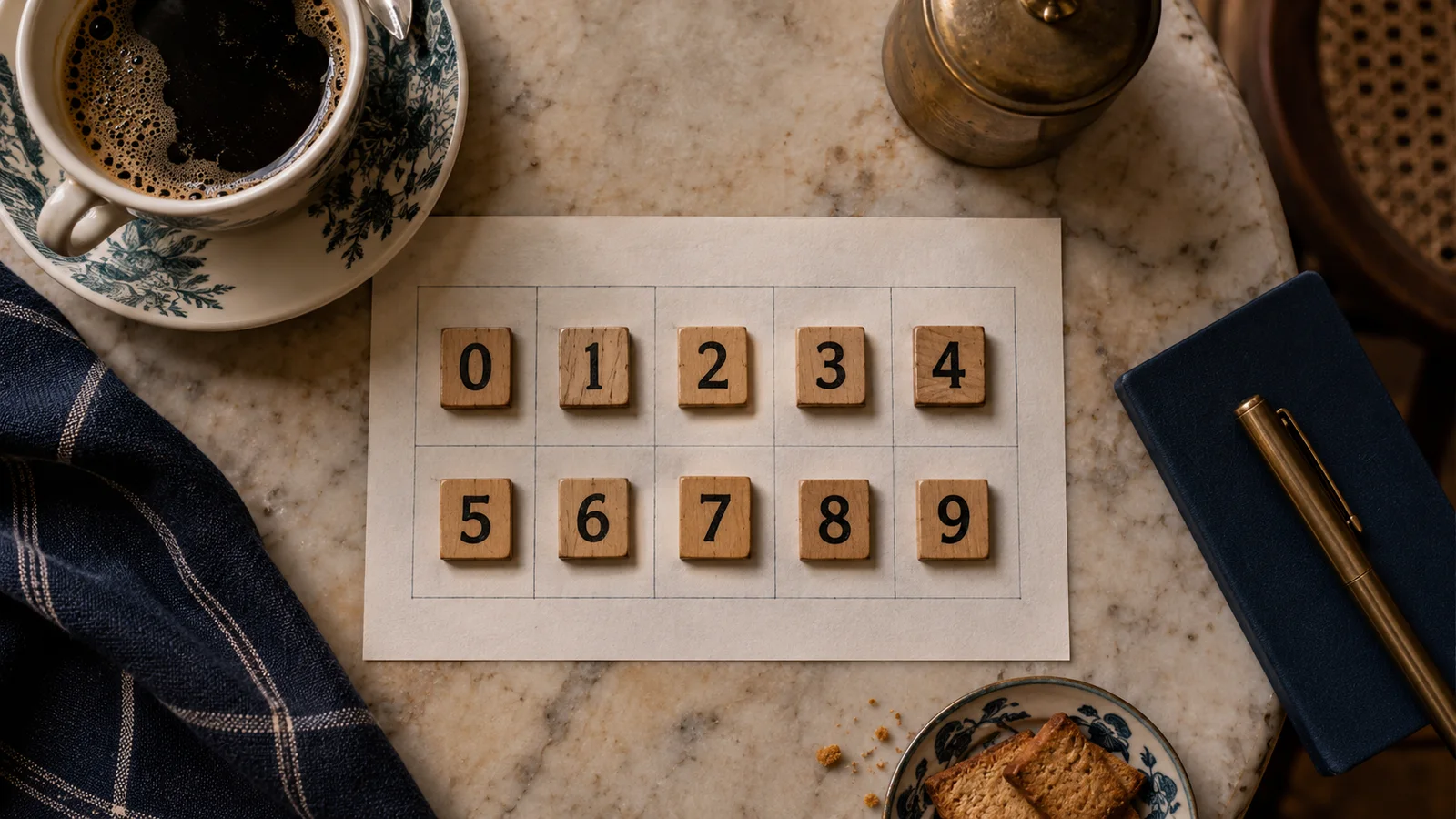
Generated editorial illustration; not a platform screenshot.
Probability examples assume a uniform, independent draw and do not describe any specific operator's draw or payouts.
The sample space
Four digits, each from 0 to 9, with leading zeros allowed, give 10 x 10 x 10 x 10 = 10,000 outcomes, from 0000 to 9999. If a draw is uniform and a single exact number is drawn for the position you care about, the chance that your exact selection matches is 1 in 10,000, or 0.01%.
The word 'if' matters. This is a statement about an ideal uniform draw. It does not describe any specific operator's draw procedure, and it does not tell you anything about prizes.
Why 1234 feels different
Humans are good at spotting patterns, which makes 1234, 7777 or 0000 stand out. When people choose numbers they tend to avoid those, so such numbers feel unlikely. The draw has no way of knowing which numbers look tidy.
A useful comparison: the sequence 7391 looks random, but it is also one specific arrangement of four digits. Out of 10,000 equally likely outcomes, each one is 'special' in the sense of being exactly itself.
Permutations change the count, not the randomness
Some products let one entry cover several orderings of the same digits. A number with four different digits, such as 1234, has 4 x 3 x 2 x 1 = 24 orderings. A number with one repeated digit, such as 1123, has 12 orderings. A number such as 1111 has just one.
If an entry covers 24 orderings and each ordering is equally likely, the chance that one of them matches the drawn number is 24 in 10,000, or 0.24%, for that single position. The entry costs more because it covers more, and any payout is whatever the operator's rules say. No payout figure is offered or implied here.
Prize categories and the operator's rules
Real products typically have several prize positions and categories, and each has its own conditions. Whether an entry wins in more than one position, how ties are handled and how payouts are scaled are all questions for the operator's own terms.
This is where the earlier ideal calculation stops being sufficient. The 1 in 10,000 figure can be correct for one position and still tell you very little about overall return, which depends on payouts the maths above does not contain.
Past results do not make a number 'due'
If a draw is uniform and independent, a number that has not appeared for 500 draws has the same chance next time as one that appeared yesterday. The belief that it is 'due' is the gambler's fallacy.
Frequency tables of past results can be interesting history. They do not carry predictive information for a properly random draw, and the random-outcome standards that regulators describe aim for exactly that independence. The UK Gambling Commission's technical standard is a conceptual reference here, not a statement about any particular operator.
A simple check you can run
Take any ten four-digit numbers you consider 'random-looking' and ten you consider 'patterned'. Count the permutations and compute the exact-match chance for each. The numbers come out the same wherever the digits are different, and they vary only with the permutation count.
If you take part in any draw, work out the total cost of the entry first and decide in advance what you are prepared to spend. Prizes are never guaranteed, and a tidy-looking number gives no advantage.
Questions readers ask
Is 0000 as likely as 4827?
In a uniform draw, yes. Every four-digit number has a 1 in 10,000 chance for a given position.
Does covering more permutations improve my odds?
It raises the chance of matching, for example from 1 in 10,000 to 24 in 10,000 for a number with four different digits, but it costs more and payouts are set by the operator.
Can past draw results predict the next draw?
Not for a properly random, independent draw. Past results describe history, not the future.
Does the 1 in 10,000 figure tell me the payout?
No. It is a probability. Payouts depend on the operator's prize rules, which you need to read separately.
Sources and further reading
- i8 Live homepage (site descriptions only)
- UK Gambling Commission: Generation of random outcomes
- UK Gambling Commission: Return to player